June Solstice Moon 🔭🌓
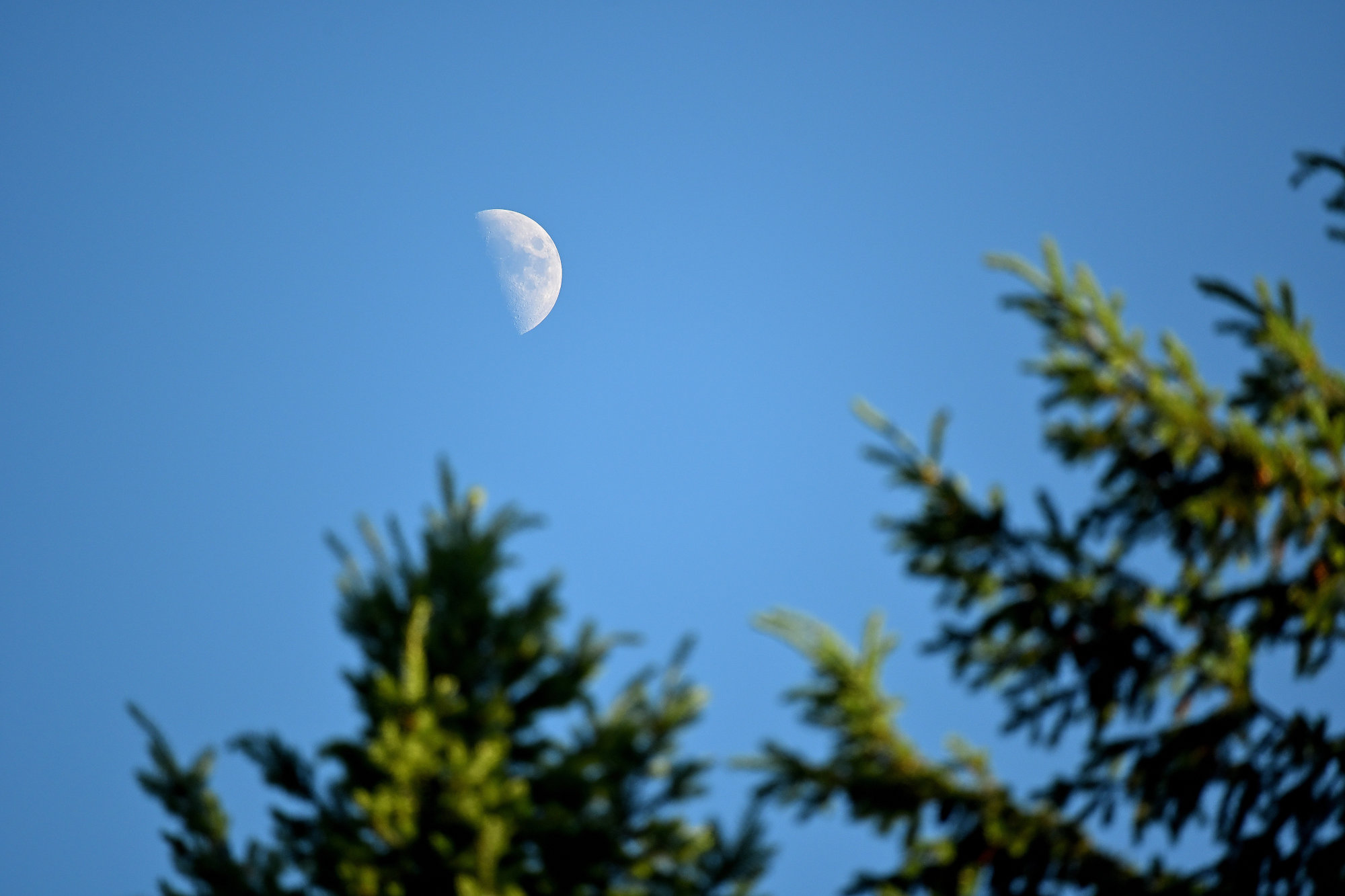
June 21st, 2026, 19:191. Summer solstice: the Sun reached its northern limit, the day stretched as far as it could, and the Moon was already visible in the blue evening sky.
The day was clearly not finished. The sky was still blue, the trees were still in sunlight, and the Moon had already arrived.
Not bright enough to take over, not faint enough to ignore. Just early.
Another moon sighting. No agents on duty this time, but the sky was clearly being monitored: Zunehmender Halbmond 🌓🌛.
Taken handheld with my Z50 and the NIKKOR Z DX 50-250 mm 1:4,5-6,3 VR. The tripod stayed inside.
1/500s f/6,3 ISO 250/25° 50-250mm f/4,5-6,3 VR f=250mm/375mm
The second image is a crop from the original 5568 × 3712 photo. The crop is 1015 × 677 pixels.
The lens was at 250 mm on a Nikon Z50. With the 1.5× APS-C crop factor, the EXIF reports this as 375 mm in 35 mm equivalent terms.
The additional digital crop factor can be calculated from the diagonal ratio:
$$ c_\text{digital} = \frac{\sqrt{5568^2 + 3712^2}} {\sqrt{1015^2 + 677^2}} $$
$$ c_\text{digital} = \frac{6692}{1220} \approx 5.49 $$
So the cropped image has an effective 35mm-equivalent focal length of:
$$ f_\text{eq,crop} = 250\,\text{mm} \times 1.5 \times 5.49 $$
$$ f_\text{eq,crop} \approx 2057\,\text{mm} $$
Or, starting from the EXIF equivalent focal length:
$$ 375\,\text{mm} \times 5.49 \approx 2057\,\text{mm} $$
In framing terms, the result is about 2050 mm full-frame equivalent.
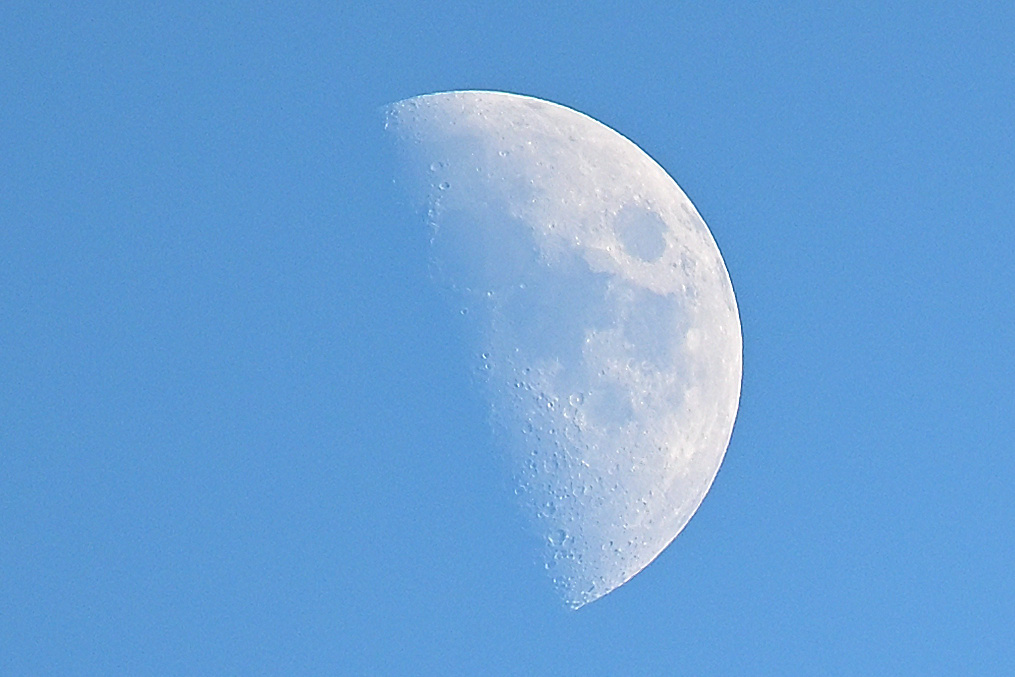
It started as 250 mm and ended up at 2050 mm. With one more zero and some cropping, the Z50 became a small handheld observatory for one evening.
-
19:19 is photo time. The solstice itself had already occurred at 01:24, when the Sun reached its northernmost declination and began its slow return south. ↩