How Much Pi Do We Really Need
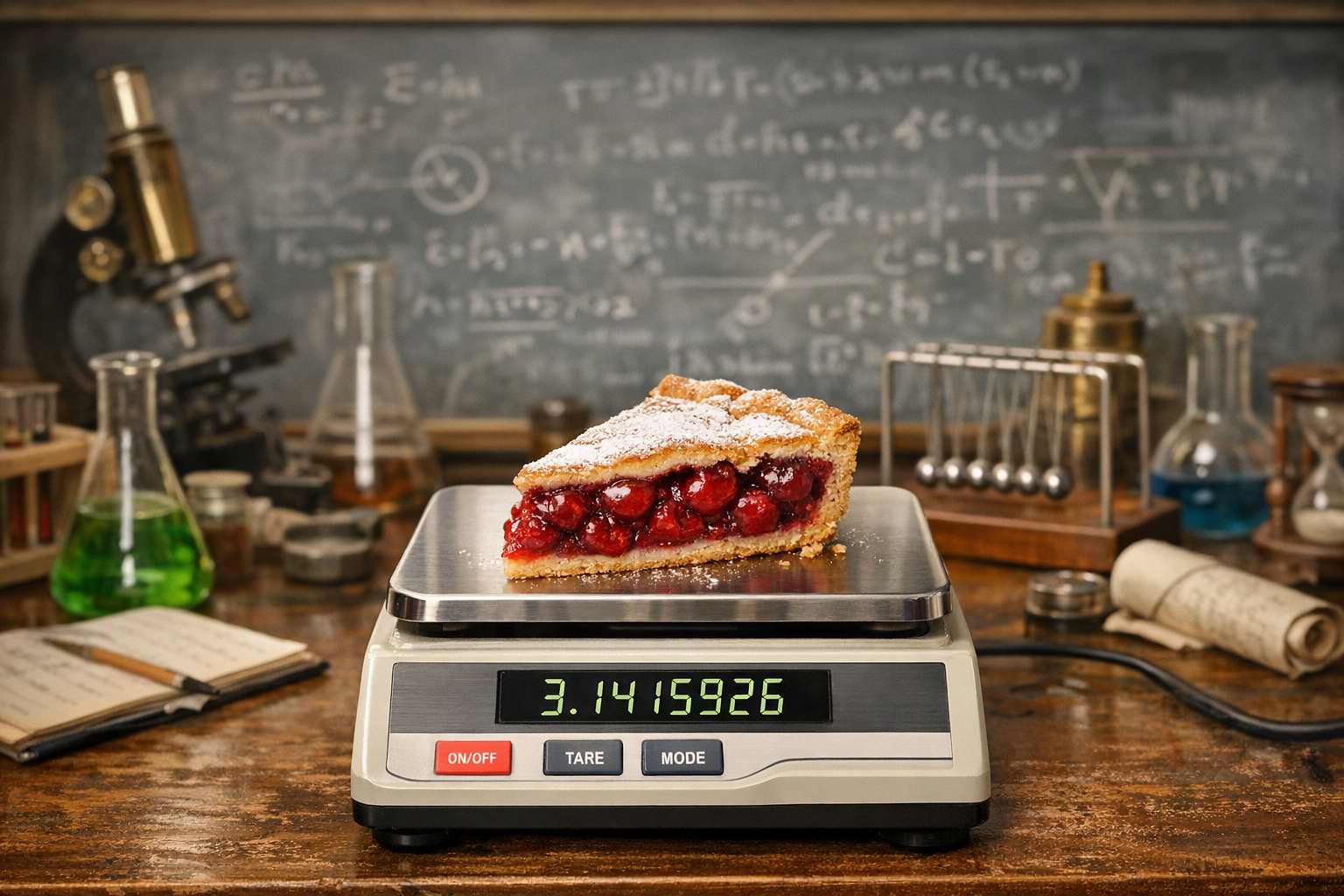
More than two thousand years ago, Archimedes2 tried to calculate the circumference of a circle. It was already known that larger circles have both a larger diameter and a larger circumference, but it was not clear whether the ratio between them would always remain the same.
By enclosing a circle between polygons with an increasing number of sides, he was able to show that this ratio is the same for every circle, and that its value can be bounded within steadily tightening intervals. Using a polygon of 96 sides, he proved that the value is contained in the interval
$$\frac{223}{71} < \pi < \frac{22}{7}$$
Archimedes narrowing the bounds
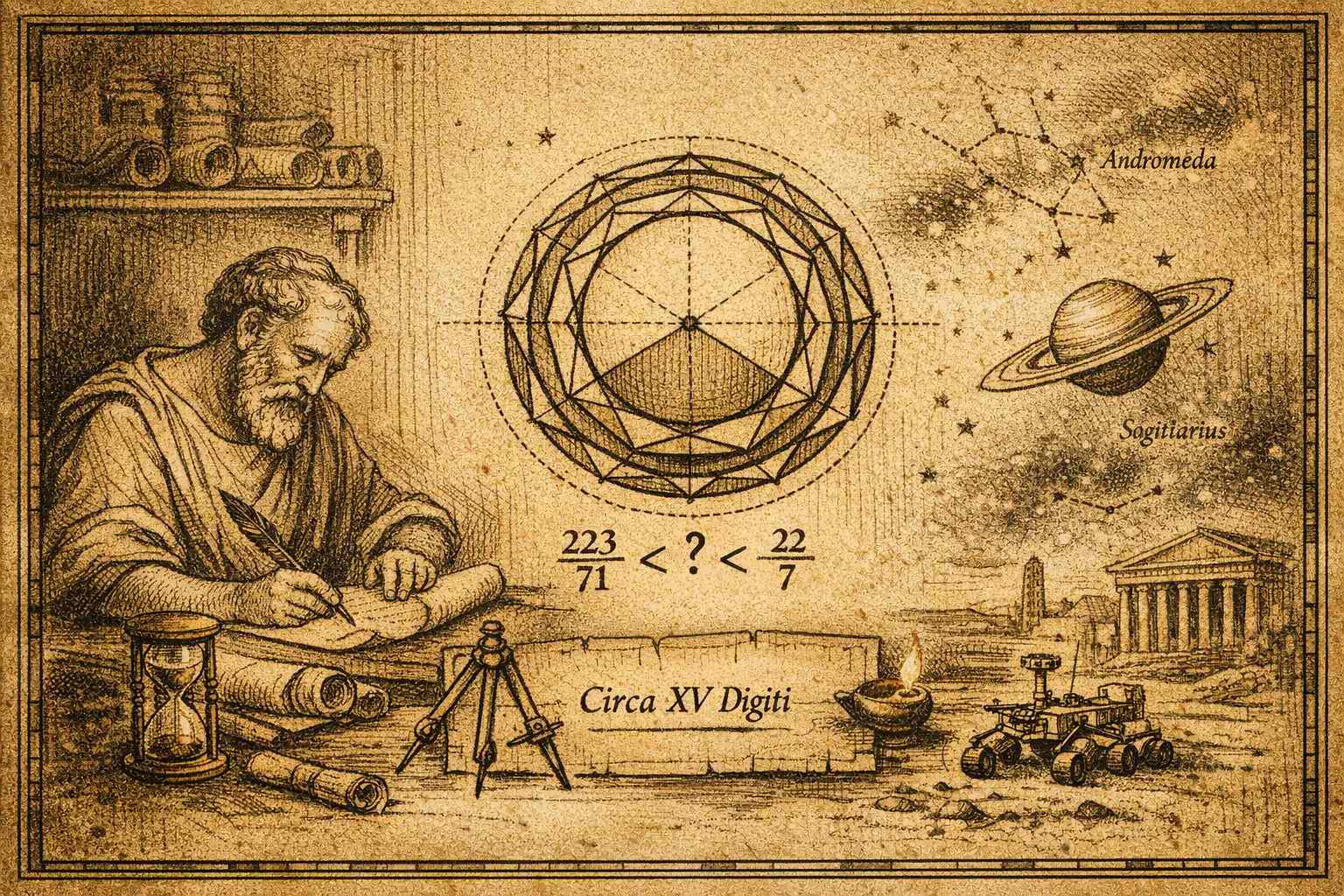
After Euler adopted the notation in 1736, the world denoted this value as $\pi$ 3
As an irrational number, its decimal expansion never repeats and never ends. And the search for more digits has never stopped.
This raises a simple question.
How many of those digits do we actually need to describe something real?
The circumference of a circle provides exactly that test.
The circumference of a circle is
$$C = \pi D$$
So any inaccuracy in $\pi$ directly affects the result.
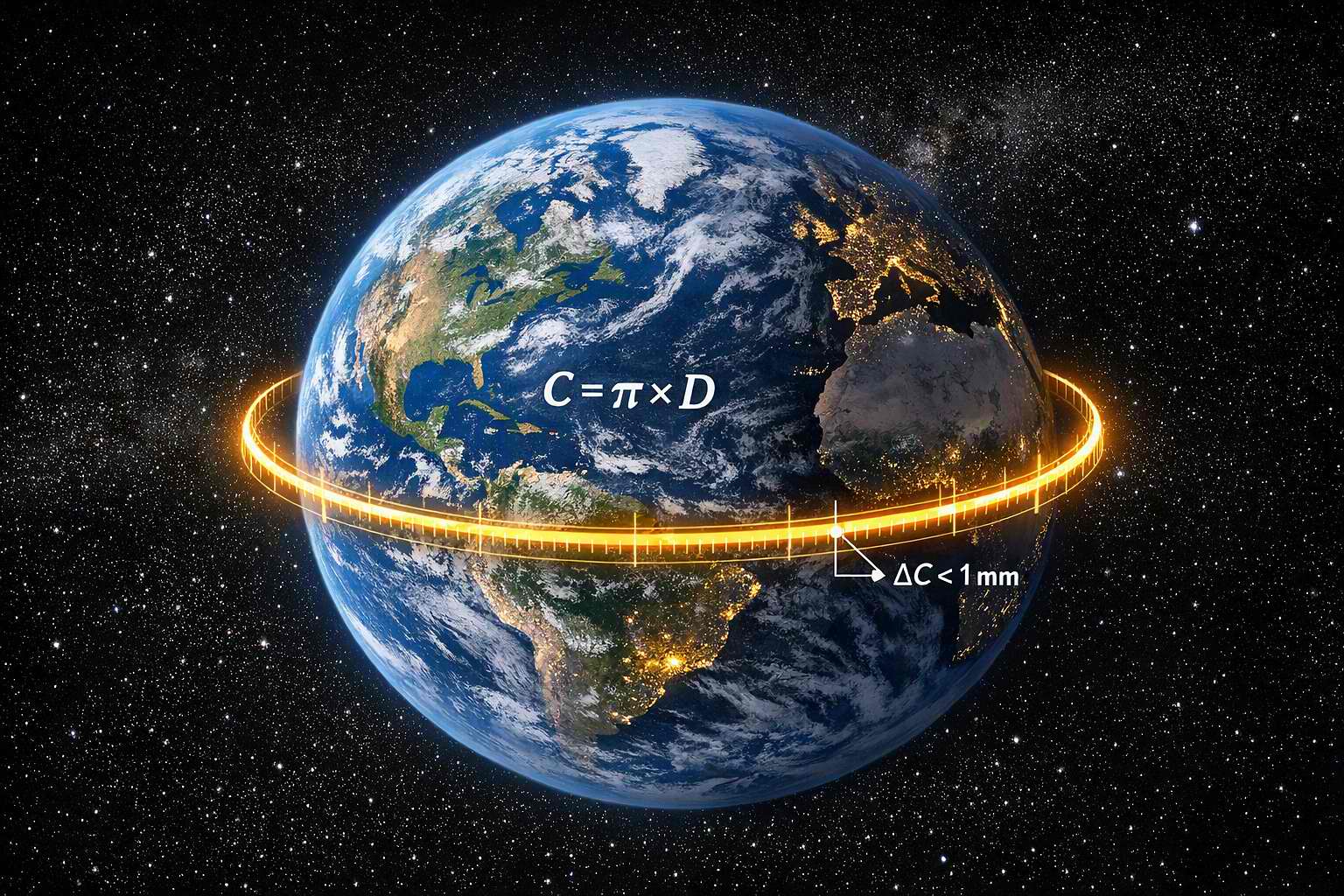
Example: The Earth
The diameter of the Earth is approximately
$$D_{Earth} \approx 12742\ km$$
We want the circumference to be correct within
$$1\ mm = 0.001\ m$$
This means the allowed error in the circumference is
$$\Delta C \leq 0.001\ m$$
Since
$$C = \pi D$$
any error in $\pi$ causes
$$\Delta C = D \cdot \Delta \pi$$
So the required accuracy of $\pi$ must satisfy
$$D \cdot \Delta \pi \leq 0.001$$
Solving for $\Delta \pi$ leads to
$$\Delta \pi \leq \frac{0.001}{12742\cdot1000}$$
$$\Delta \pi \leq 7.85 \times 10^{-11}$$
That corresponds to roughly 10 decimal places of $\pi$. Using 10 places results in an error of about $10^{-11}$, which is within the required bound.
So if you use
$$\pi_{10} = 3.1415926536$$
you can calculate the circumference of the entire Earth with an error smaller than one millimeter.
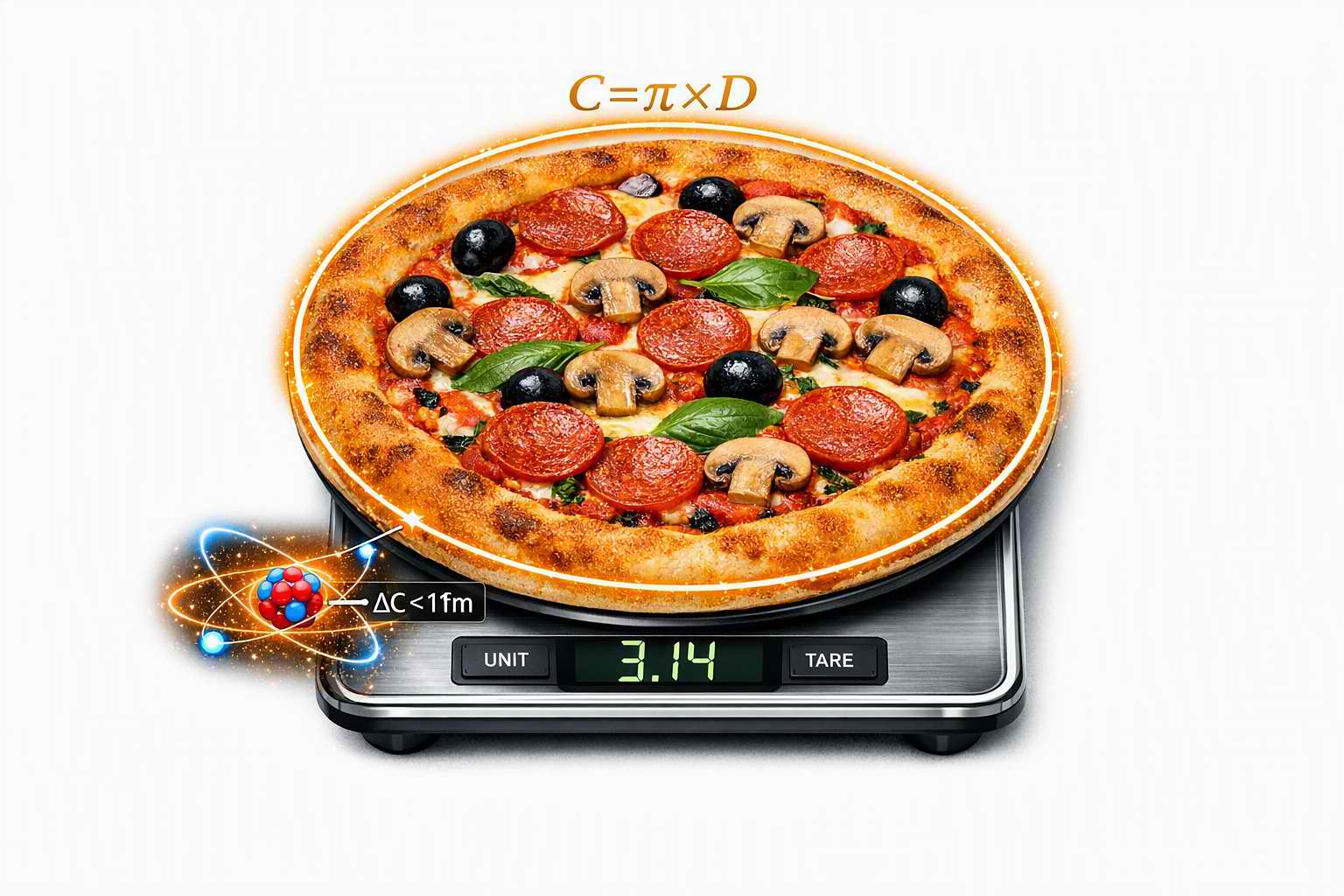
Example: A Pizza
The diameter of a pizza is approximately
$$D_{Pizza} \approx 0.30\ m$$
This time we set the target accuracy to the diameter of an atomic nucleus
$$1\ \text{fm} = 10^{-15}\ m$$
Applying the same formula leads to
$$\Delta \pi \leq \frac{10^{-15}}{0.30}$$
$$\Delta \pi \leq 3.3 \times 10^{-15}$$
That corresponds to roughly 15 decimal places of $\pi$.
So if you use
$$\pi_{15} = 3.141592653589793$$
you can calculate the circumference of a pizza with an error smaller than the diameter of an atomic nucleus.
Example: The Observable Universe
Now let us scale things up.
The diameter of the observable universe is estimated at roughly
$$D_{Universe} \approx 8.8 \times 10^{26}\ m$$
Using the same formula with a target accuracy of 1 mm, as in the Earth example, leads to
$$\Delta \pi \leq \frac{0.001}{8.8 \times 10^{26}}$$
$$\Delta \pi \leq 1.14 \times 10^{-30}$$
That corresponds to roughly 30 decimal places of $\pi$.
So if you use
$$\pi_{30} = 3.141592653589793238462643383279$$
you can calculate the circumference of the entire observable universe with an error smaller than one millimeter.

Conclusion
Ten digits of $\pi$ are enough for planetary scale.
Fifteen digits are enough to measure a pizza to the width of an atomic nucleus.
Thirty digits are enough for cosmic scale.
Beyond that, the digits describe no physical quantity we can measure, only the internal consistency of mathematics itself.
Fifteen digits are also exactly what NASA uses to navigate spacecraft across the solar system, the same precision that measures a pizza to the width of an atomic nucleus.
They have not yet missed a planet.
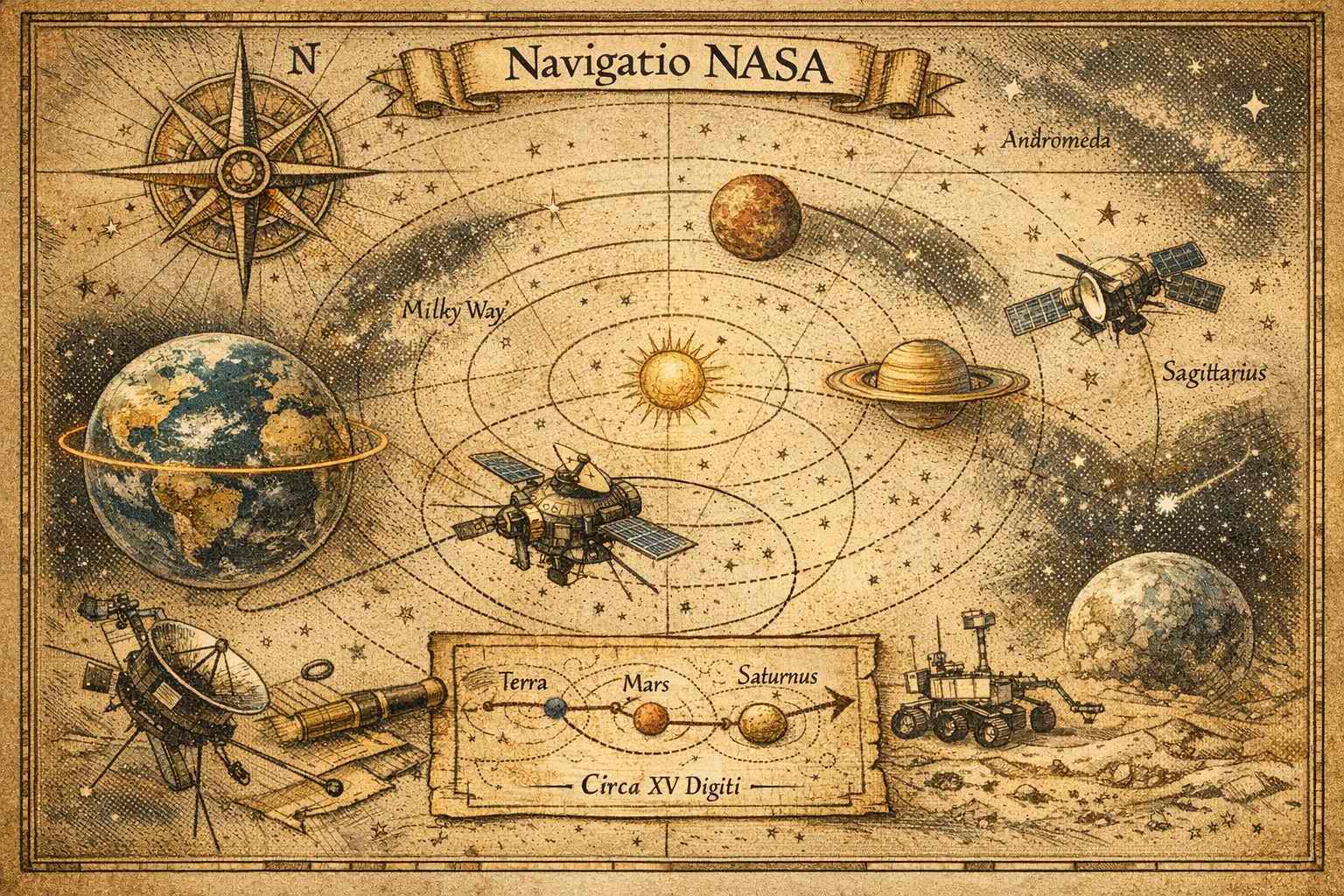
Interplanetary navigation with finite precision
See also Engineering Pi Day
-
The lab has seen many upgrades.
 The Pie remained entirely indifferent.
Even they could not find a pattern.
Archimedes' office, circa 250 BC. The Pie was already indifferent. ↩
↩ -
Archimedes of Syracuse (c. 287-212 BC) derived his bounds on π in Measurement of a Circle. A result that stood as the standard approximation for centuries. ↩
-
$$\pi_{314}=3.14159265358979323846264338327950288419716939937510582097494459230781640628620899862803482534211706798214808651328230664709384460955058223172535940812848111745028410270193852110555964462294895493038196442881097566593344612847564823378678316527120190914564856692346034861045432664821339360726024914127372458700660631$$ ↩